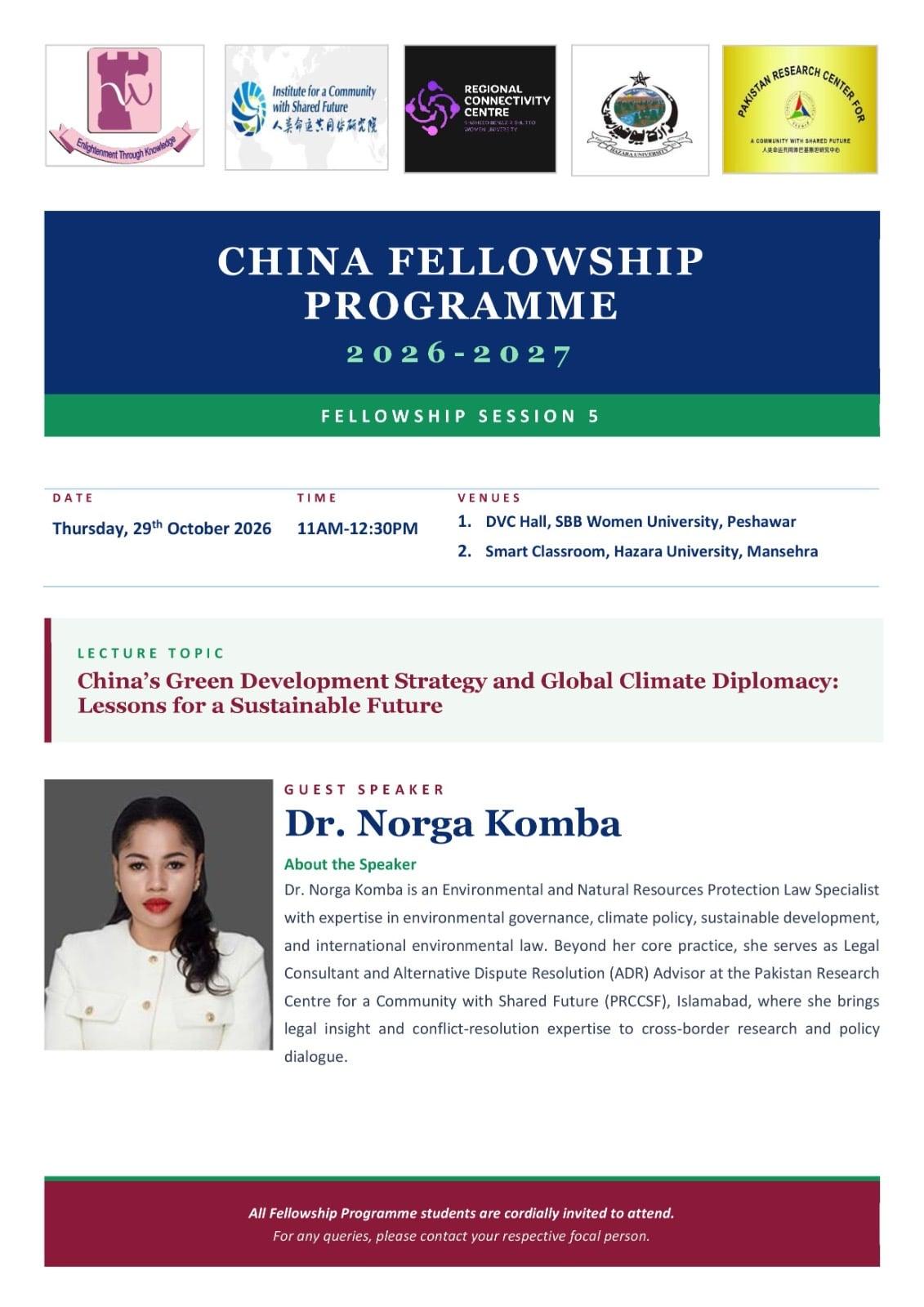
On 29th October 2026, the fifth session of the China Fellowship Programme 2026–27 was held at the Regional Connectivity Center (RCC), Shaheed Benazir Bhutto Women University (SBBWU), Peshawar, and the Department of Political Science & International Relations, Hazara University, Mansehra. The China Fellowship Programme 2026–27 is jointly organized by the Pakistan Research Center for a Community with Shared Future (PRCCSF) in collaboration with the Embassy of the People's Republic of China in Pakistan, with the support of the Institute for a Community with Shared Future (ICSF), Communication University of China (CUC), Beijing.
The session was led by Dr. Norga Komba, an Environmental and Natural Resources Protection Law Specialist with expertise in environmental governance, climate policy, sustainable development, and international environmental law. She also serves as Legal Consultant and Alternative Dispute Resolution (ADR) Advisor at the Pakistan Research Center for a Community with Shared Future (PRCCSF), Islamabad, where she contributes legal insight and conflict-resolution expertise to cross-border research and policy dialogue.
Green development
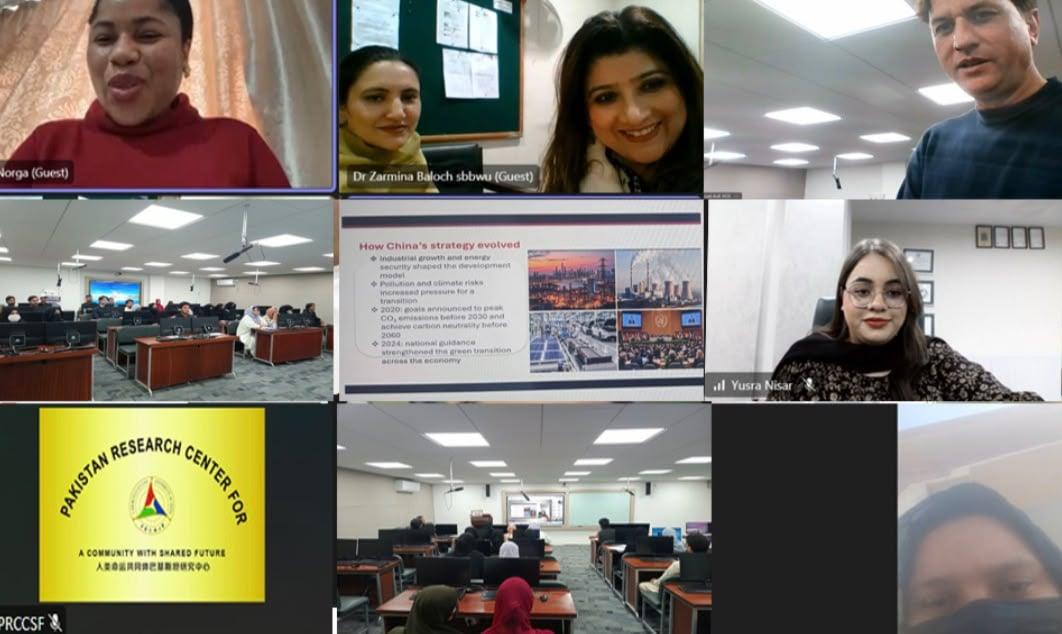
During the session, Dr. Norga Komba delivered a comprehensive lecture on "China's Green Development Strategy and Global Climate Diplomacy: Lessons for a Sustainable Future," opening with the question of whether a green development model built on rapid industrialization can become a model for a low-carbon future. She explained the meaning of green development, including economic growth with lower resource use and pollution, decarbonization of electricity, industry, transport and buildings, circular economy practices, and climate adaptation. She traced the evolution of China's strategy, including the 2020 pledge to peak CO₂ emissions before 2030 and achieve carbon neutrality before 2060, and outlined the policy toolkit behind it. She also highlighted the rapid scale-up of renewable energy, electric mobility, high-speed rail, green buildings and urban resilience.
Climate diplomacy
Turning to climate diplomacy, the speaker discussed China's engagement through the UNFCCC and the Paris Agreement, and its 2035 Nationally Determined Contribution (NDC), announced in September 2025. She also examined climate finance, trade and technology transfer, China's cooperation with the Global South, and the mixed record of green and fossil-fuel investment under the Belt and Road Initiative. She stressed that the credibility of climate diplomacy depends on transparent data, near-term emissions reductions, and a managed transition for workers, alongside continued challenges such as coal reliance and rising electricity demand.
Lessons for developing countries
Dr. Norga further shared practical lessons for developing countries, including planning grids, storage and transmission alongside renewable generation, using public procurement and stable policy to build local supply chains, and evaluating projects on life-cycle cost, climate impact, jobs and skills transfer. She presented a practical scorecard for assessing green partnerships across climate, economic, social, governance and delivery dimensions, and led a mini case discussion comparing a low-cost solar project with one offering grid upgrades, training and public reporting.
Discussion
Students actively participated in the question-and-answer session, exchanging perspectives with the speaker on which parts of China's experience are most transferable to Pakistan, the conditions that should accompany climate-related foreign investment, and how countries can balance energy security, affordability and decarbonization. The discussion encouraged students to critically examine the opportunities and challenges shaping green development and global climate cooperation.
The session was moderated by Ms. Yusra Binte Nisar, Research Assistant at the Pakistan Research Center for a Community with a Shared Future (PRCCSF), who facilitated the discussion and encouraged students to engage with the subject through questions and critical analysis.